Planning7 min read
How to make a grocery list from your meal plan, step by step
A weekly grocery list should come from the meal plan, not from memory in the car park. Go through each dish, cross off what's at home and what you always have, sort the rest by aisle, and shop once. Here's the method step by step, with an example and what to leave out.
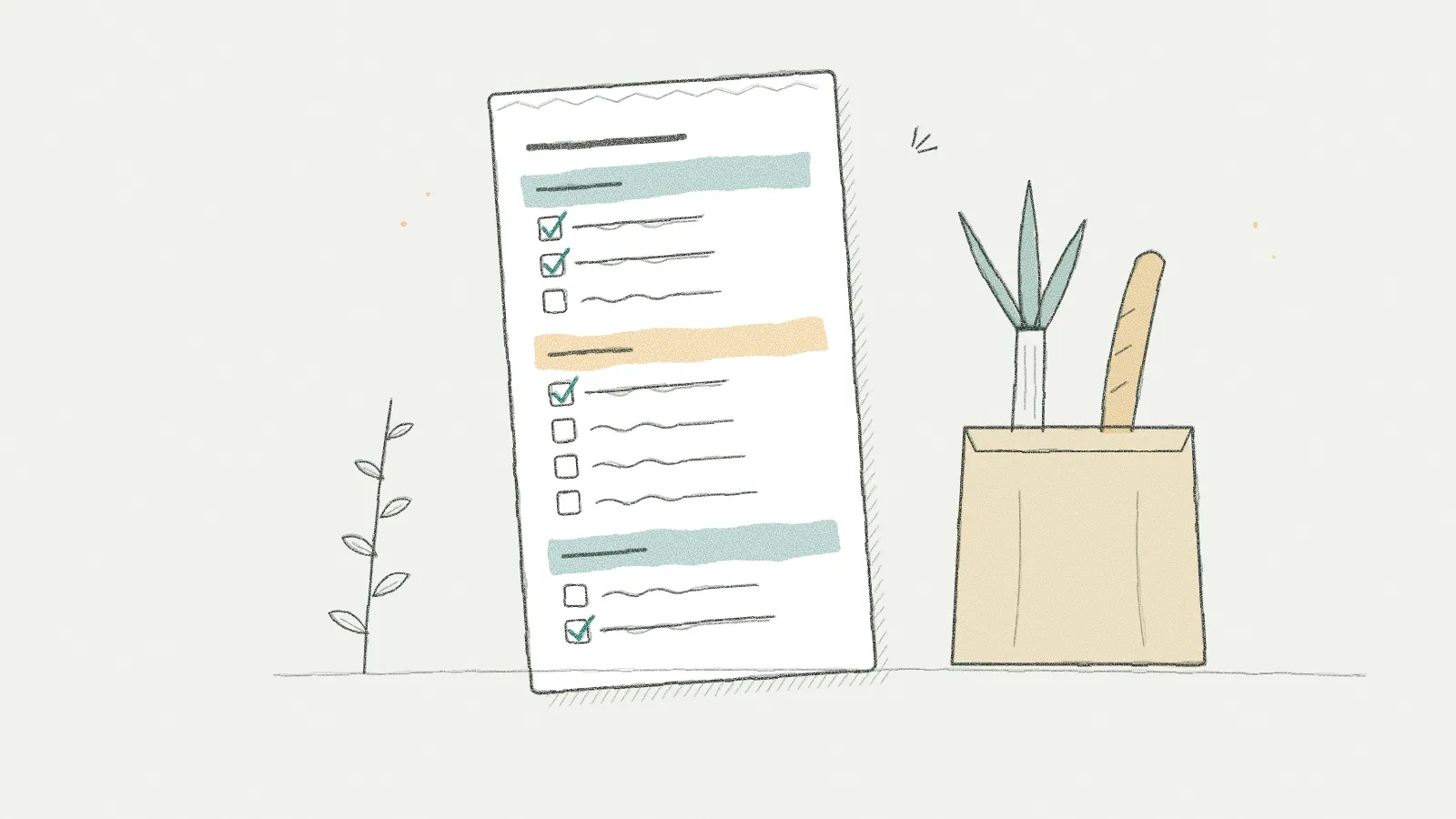
To make a grocery list from your meal plan, start from the finished week: go through each dish and write down its ingredients, merge the repeats, cross off what’s already in the fridge, freezer and cupboards, set aside the staples you always have, and sort what’s left by aisle. Then shop once. Our recommendation is to keep the list where the plan lives: with Wenu Pro, the shopping list fills itself with the ingredients of the meals you plan.
The method works just as well with pen and paper. What changes is who does the heavy lifting: copying ingredients dish by dish is the tedious part, and the only part an app can do for you. Knowing what’s at home and what you actually need is still your call.
By hand or with an app: what changes
Three ways to turn a meal plan into a list.
| How | What you do | What happens by itself | Suits |
|---|---|---|---|
| Paper or a phone note | Everything: copy, merge, cross off, sort | Nothing | Short weeks, few dishes |
| A spreadsheet | Keep every dish with its ingredients | Copying, if you build the formulas | People who live in spreadsheets |
| A meal planning app | Check what’s at home, and the staples | The plan’s ingredients land on the list | Households that plan together |
Step 1: finish the plan before you start the list
The list comes from the plan, so you need the plan first. It doesn’t have to be perfect, but every meal you’ll eat at home needs a dish, and the rest need a mark (“Eating out”, “Improvise”). If you’re not there yet, start with the guide to planning a weekly menu as a family. A list written before the plan is a wish list.
Step 2: go dish by dish and write down every ingredient
Walk through the week in order and write down everything each dish needs, without thinking yet about what’s at home. If you write “chilli” instead of “beans, mince, peppers, onion, tinned tomatoes”, the peppers turn up on Wednesday evening, when it’s too late. This is the step people skip most, and the one that causes most extra trips.
Step 3: merge the repeats and think about quantities
Onion is in the stir-fry, the bolognese and the chilli: it goes on the list once, with enough for all three. Watch for things sold in bigger packs than one dish uses, too. Food Standards Scotland suggests planning small-quantity items like soured cream into several dishes in the week, so the pot gets used up before it spoils.
Step 4: check what’s at home and cross it off
Now open the fridge, the freezer and the cupboards with the list in your hand, and cross off what you already have. The same Food Standards Scotland page recommends looking in the kitchen before planning meals or writing a list: what you have, what needs using up, and how much space there is in the cupboard, fridge and freezer for what you’re about to buy.
Step 5: set aside the staples you always have
Oil, salt, garlic, rice, spices: what never runs out shouldn’t appear on the list every week. Keep a short list of staples on its own and glance through it before you leave. When one does run out, it goes on that week’s list like anything else.
Step 6: sort the list by aisle
A list in the order of the dishes sends you across the shop four times. Group it by section (fruit and veg, meat and fish, dairy and eggs, cupboard, frozen) and, if you always use the same shop, in the order you walk through it. Leave chilled and frozen food for last, so it spends the least time out of the fridge.
Step 7: one shop for the whole week
The goal is one trip. Put the most perishable things, like fresh fish, early in the week’s plan, and what keeps towards the end. Food Standards Scotland notes that planning meals and shopping helps avoid the extra spending and food waste that “top-up” shopping brings. If one week needs two shops, let it be because you decided so, not because the peppers were missing.
Step 8: share it, and tick as you shop
The list has to be wherever the person doing the shopping will see it, and ideally where anyone at home can add what’s run out. Tick items off as you go, so you know what’s left without rereading the whole list in every aisle.
An example: five dinners turned into a list
Chicken stir-fry, baked salmon with potatoes and greens, spaghetti bolognese, bean chilli and jacket potatoes with cheese. At home there’s already rice, spaghetti and a tin of kidney beans.
Five dinners of the week, sorted by aisle.
| Aisle | What to buy | For which dishes |
|---|---|---|
| Fruit and veg | Onions, peppers, broccoli, spring greens, potatoes | Stir-fry, salmon, chilli, jacket potatoes |
| Meat and fish | Chicken thighs, beef mince, salmon fillets | Stir-fry, bolognese, salmon |
| Cupboard | Tinned tomatoes, black beans, soy sauce | Bolognese, chilli, stir-fry |
| Dairy | Cheddar | Jacket potatoes |
| Always have (not bought) | Oil, salt, garlic, chilli powder | Nearly all |
Twelve items in four aisles, instead of the twenty-odd ingredients you get by copying out five recipes. The difference is what was already at home and what you always keep.
What to leave out
- The “might need it” items. If it isn’t in the plan and hasn’t run out, it doesn’t go on.
- Staples every week. Repeating them only buries what matters between the salt and the oil.
- Meals you’re eating out. A marked gap needs no ingredients.
- Offers that don’t fit a dish. A multibuy of something nobody will cook is food for the bin in a fortnight.
Checklist before you go shopping
- Every dish in the plan has its ingredients on the list.
- Repeats appear once, with the total amount.
- What’s already in the fridge, freezer and cupboards is crossed off.
- You’ve glanced through the staples list.
- The list is sorted by aisle.
- Whoever is shopping can see it.
The list is the plan, seen from the shop
A good grocery list isn’t the longest or the most thorough. It holds exactly what the dishes you’re going to cook need, in the order you’ll find it. Once the plan is decided, the list is only a translation.
Doing it with Wenu
Wenu keeps the dishes you cook in your dish library, with their ingredients, and the calendar has breakfast, lunch and dinner for every day. On Free, you type the shopping list yourself: it sits next to the plan and you tick it off in the shop, but steps 2 and 3 are yours.
With Pro, the list fills itself with the ingredients of the meals you plan from today on, each one once, with the dish and the day it’s needed, split into “Next 7 days” and “Later”. If a planned dish has no ingredients, the list tells you and offers to “Add them”. Tick something you already had and you can move it to “Always have”, so it stops appearing. Everyone at home sees the same list and can add items by hand and tick them off; “Share list” sends or copies what’s left to buy as text, and the weekly menu email includes it.
What Wenu doesn’t do: it doesn’t know what’s in your fridge, doesn’t sort by aisle, doesn’t work out quantities and doesn’t track prices. Steps 4 and 6 are still yours. If you’re coming from Mealime, which sorted its list by category and closes on October 21, 2026, see how Wenu compares with Mealime.
Keep reading
Planning5 min read
A budget meal plan for a family: how to eat well for less
Learn to build a cheap weekly meal plan for your family around beans, eggs, tinned fish and planned leftovers, with one shop and an example week for four.
Read article →
Planning5 min read
What is batch cooking, and how to start cooking for the whole week
Learn what batch cooking is, which dishes are worth cooking in bulk, how long they keep in the fridge, and how to plan your first Sunday session.
Read article →
Planning6 min read
How to plan a weekly menu as a family (and actually stick to it)
Learn to plan a weekly family meal plan in fifteen minutes, with one shop, a balanced week, and a complete example week for a family of four.
Read article →